Fossil fuels: wood, coal, oil, natural gas, etc. are limited resources. The earth’s supply will eventually be exhausted. However, will we even need fossil fuels by the time they become scarce? Humans have a remarkable ability to adapt to changing circumstances. Will humanity adapt or be caught flat footed? We are more likely to be caught flat footed if we let government make choices regarding our energy future. Government is more than willing to take charge if we allow them (we should not). Should we instead continue to let the energy market progress as it has since the start of the industrial revolution? Fossils fuels are an ogre for many, but we should examine our choices carefully and rationally.
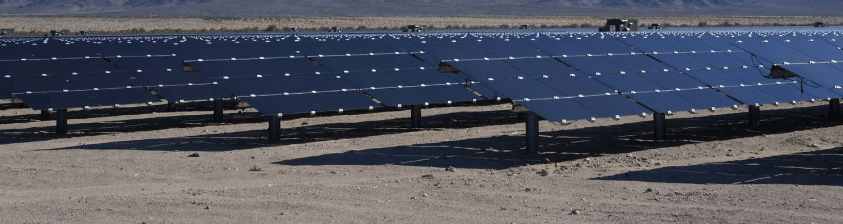
Nobody claims fossil fuels are renewable, but wind and solar will never run out, right? Renewable energy provides hope for many that mankind will have a sustainable, virtually never-ending fuel source. Another highly touted benefit is that renewables don’t have the negative environmental impact of fossil fuels nor the potential dangers from nuclear (fission) energy. Electric vehicles too are cleaner burning than gas powered vehicles, and therefore deemed better despite their higher cost and lower reliability. But have we examined the total cost of renewables?
https://www.energysage.com/about-clean-energy/advantages-and-disadvantages-of-renewable-energy
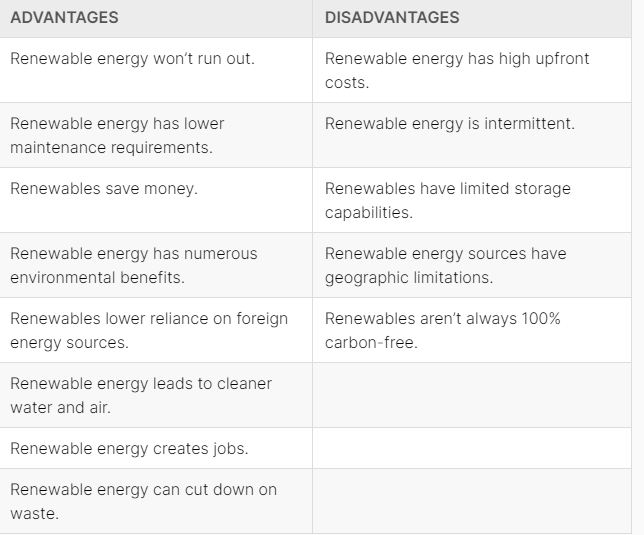
https://www.pnnl.gov/explainer-articles/renewable-fuels
There are numerous benefits to using renewable fuels. Renewable fuels will help us achieve net-zero carbon emissions and reduce greenhouse gases. Renewable fuels provide a sustainable alternative to traditional, non-renewable resources such as petroleum.
Such notions of renewable energy are axiomatic, no-brainers, for many. The public rarely bothers to question the renewable energy axioms, but we should dig deeper. Going all in for renewables often means siding with the environment and against industrialization. Further, you fulfill a fundamental human desire to be the good guy, among those who save humanity from our worst tendencies. Therefore, anyone who raises doubts about our renewable energy choices is labeled a climate denier, probably someone who doesn’t care about people, someone siding with rapacious businesses seeking the almighty dollar. How can folks like me even question the righteous path of renewable energy?
However, painting our choices in such stark black and white terms is not intellectually rigorous. It is the easy path to morality, like getting healthy without proper diet or exercise. We must study our options more closely and not resort to facile statements declaring one particular energy source to be moral and others to be opposed at all costs at any level. Reducing CO2 at the cost of human prosperity, especially for the poorest among us, is not necessarily moral. Are all the advantages listed on the left side of the ledger completely true? Can they withstand scrutiny? Are they truly axiomatic?

Environmental Cost of Renewables
While solar and wind do not produce carbon emissions or greenhouse gases, they do come with environmental costs rarely considered. Certainly, the sun’s nuclear fusion energy will not expire for billions of years, but can mankind harness the sun’s power forever and ever using today’s technologies? Dr. Scott Tinker (geologist and energy expert) makes a simple, but what would for many a shocking claim in an interview with Dr. Jordan Peterson: there are actually no renewable fuels. https://www.youtube.com/watch?v=fp_k47uS2DA. He provides a number of other important insights as an expert who knows the topic.
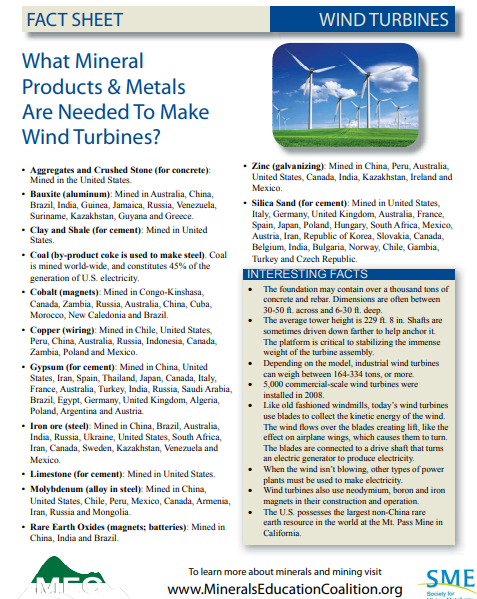
To harness the sun’s power a great many minerals (resources limited in the same way gas, coal, and fossil fuels are limited) are needed to produce solar panels. In other words, our renewable energy is dependent on non-renewable natural resources. Go figure. In addition, such natural resources are sometimes controlled by hostile foreign actors, and so they may not be as readily accessible as fossil fuels.
solar-panel-problems-and-solutions
But manufacturing the solar panels necessary for such a huge increase in solar power production will require a surge in the mining of raw materials. There are myriad problems that exist with the mining of silicon, silver, aluminum, and copper needed to make solar panels. Can governments and companies ensure that workers in the solar supply chain benefit from safe, just, and well-compensated livelihoods—and that the communities most affected are involved as active collaborators, treated with respect and dignity?
Perhaps Dr. Tinker makes a valid point? This is a quite lengthy list of natural resources needed to develop solar panels and wind turbines. The solar panels and wind turbines must be replaced over time continually driving the requirement for more natural resources. Behold a “renewable” energy source dependent upon the mining of materials which, like petroleum, may run or out or our access to them may be restricted.
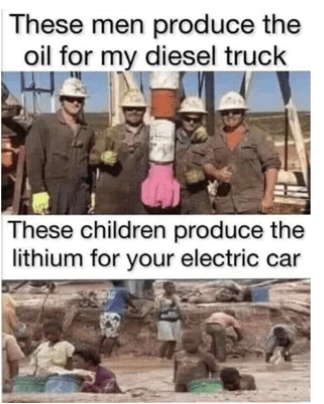
Can we square this dependency on mining with the belief that renewables are wholly good for the environment? Perhaps mining for all these natural resources needed for solar and wind power has less environmental impact than drilling for oil? That is possible, but who among us believes that mining or drilling for anything is a totally environmentally safe process?
Somehow the solar panel and the wind turbine magically appear to provide us with clean energy? Yes, the energy may be clean from that point forward (or at least until solar panel or wind turbine needs to be disposed), but there were many eggs broken first. Furthermore, many of these natural resources are mined in countries which, in fact, have far fewer environmental protections (not to mention labor protections) than the U.S. has when drilling for oil. It seems the plot thickens.
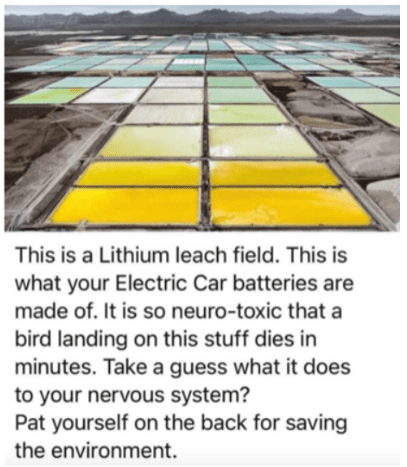
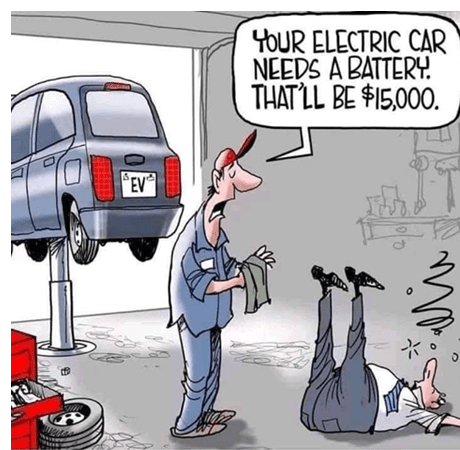
What about electric vehicles? Many Americans believe they are helping to protect the environment by buying EVs. Certainly, EVs have no emissions unlike gasoline powered vehicles. However, why consider only the negative environmental impacts of gasoline powered vehicles but ignore EVs impact? The environmental costs of EVs starts with its fuel source, the lithium-ion battery.
how-electric-car-batteries-are-made
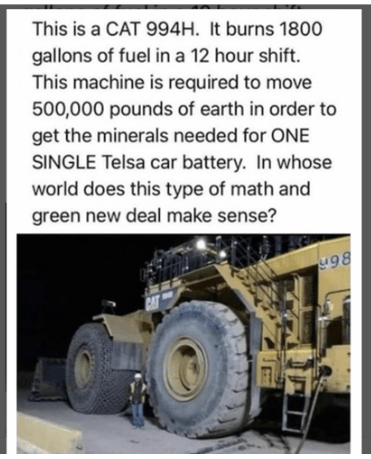
the journey that these lithium-ion batteries make when being produced is a very interesting one: from multiple (sometimes unsafe) mines in far-off countries to being packaged into a powerful, high capacity battery which can drive a car forward at very high speeds.
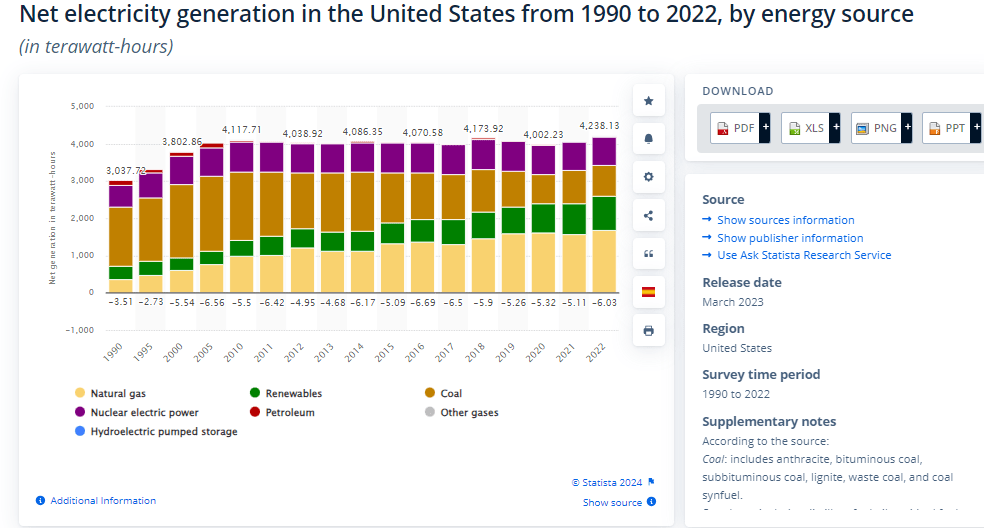
In addition, the electric power for EVs may or may not come from a clean-burning source. Fossil fuels account for more than half the electric generation in the US. Perhaps, EVs should be labeled coal-burning cars instead? That label might impact the perspective of people who credit themselves for helping to save the planet.
https://www.statista.com/statistics/220174/total-us-electricity-net-generation-by-fuel
The Current Situation
The short initial primer is only to demonstrate that renewables are not always accurately represented. Many have a far too Pollyannaish view of renewables, seeing only their advantages and not considering their limitations. There are indeed issues with fossil fuels as well but I don’t want to highlight these or even try to offer a comparison. Instead, the question to ask is: are we on the right energy path or are we veering off in the wrong direction? Are renewables our future or should we stick with fossil fuels or a combination of both? Are there newer and better sources on the horizon? How do we determine the appropriate use of each of our diverse energy sources? We clearly cannot eliminate any one source, especially not the widely used fossil fuels. In addition, we ought to demand our scientists analyze these questions and our politicians accurately represent our choices instead of pushing the silly good energy choices/bad energy choices paradigm. I am afraid cogent consideration of such questions is quite rare in today’s hyper-political environment. At least, Drs. Tinker and Peterson dispassionately discuss such questions in the interview I reference (https://www.youtube.com/watch?v=fp_k47uS2DA).
Much of the current debate centers around C02 (carbon dioxide) levels. Is 420 parts per million (ppm), the current level of C02 in the atmosphere a good level or not? If 420 ppm is not appropriate, what should the CO2 level be? There appear to be are no simple answers. However, simply discussing C02 levels can be difficult. Many prefer instead to talk of the morality of C02 levels, again reducing the argument to a one side good/one side bad paradigm. That is a political argument and it is ridiculous.

“Millennials and Gen Z and all these folks that come after us are looking up, and we’re like, ‘The world is going to end in 12 years if we don’t address climate change, and your biggest issue is how are we gonna pay for it?’ Alexandria Ocasio-Cortez, January 2019
Indeed, CO2 levels have risen significantly since the start of the industrial revolution, but that increase has also come with many benefits to our civilization as well, including a massive greening of the planet. You can focus on one side or the other of the equation, but both these facts are true (although, I should add, we do have more than seven years before climate change ends civilization).
CO2 is less than 1% (.04% roughly) of the air we breathe, yet this minimally present gas is essential to all life. Increasing it has proven a boon to plant life, yet the EPA ten years ago declared this gas to be a pollutant. The impact CO2 has on temperature is still being debated (read more of the literature if you doubt me), although many reflexively declare the science settled. I am very dubious when anyone declares any topic settled. There are points on either side, but climate science is anything but settled.
The graph below shows CO2 levels have been significantly higher in the past and the earth’s climate did not careen out of control during those eras. On the other hand, the change in the last two-hundred years has been significant. The projections for the next few centuries are also shown below. Are those projections accurate, and if they are, what does the sudden rise mean for us? Is a massive C02 increase inevitable, and if it actually happens, is it truly the end-of-the-world?
We have to address such questions dispassionately and not veer towards the ever-so-popular my side good/ your side bad paradigm. Otherwise, we will never agree and we will come to the right mitigating measures or energy policy.
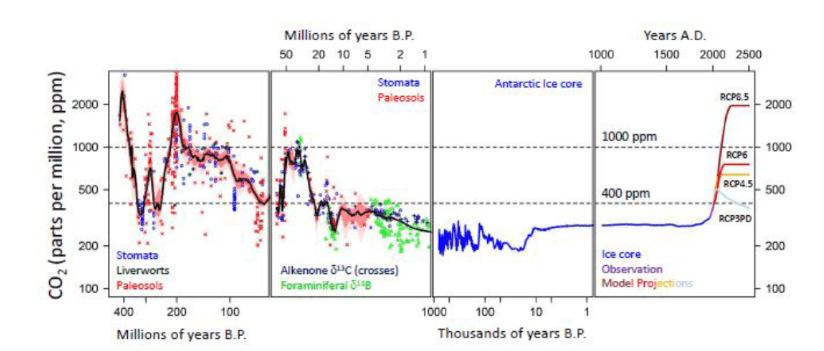
Temperatures on the earth and sea levels are indeed rising today, but they have steadily risen for thousands of years–since the end of the last ice age. In fact, earth’s temperatures and sea levels have risen and fallen repeatedly, following cycles lasting hundreds of thousands, or in some cases, millions, of years. Has the industrial revolution which is not even two-hundred years in the making, dramatically altered that cycle? You can legitimately arrive at virtually any conclusion regarding our climate future depending upon the years included in analyzing this question. For instance, one could say C02 levels today are inordinately high or inordinately low depending upon the starting point.
Dr. Peterson asks Dr. Tinker, around minute twenty-five for his assessment of the current situation. During the last five million years, Dr. Tinker tells us, the earth has seen nearly fifty cycles during which the earth freezes and then thaws, with dramatic rising and falling temperatures and sea levels, changes we almost cannot comprehend today. Rinse and repeat over and over. Why do our contemporaries seem to believe the climate has always been as it now or that today’s climate is the perfect one? Dr. Tinker acknowledges the earth was healthy even during those periods when CO2, temperatures, and sea levels where far higher than today. In addition, he asserts (providing evidence and an explanation), we are currently living in one of the coolest periods in the earth’s history. So, are we simply caught up in the most current cyclical warming period or is mankind truly altering these climate cycles?
Dr. Tinker talks also of the sea level rise, another hotly debated topic. He clearly states sea levels are indeed rising, but he adds they have been rising on average of one to two millimeters per year for the last 7,000 years. This estimate is entirely consistent with other projections for the last century. The rate, per the article below, is increasing, doubling since the start of the century. Still, even if I am living at the water’s edge, a six-inch or even twelve-inch rise over the average human lifespan, seems a manageable pace.
Dr. Tinker provides a fascinating analysis of human progression through various energy sources, from reliance on wood and beasts of burden for most of civilization to reliance on coal (mainly carbon) in the mid-19th century and progression to hydrocarbons (e.g. gasoline, diesel), and beyond. He credits the use of coal to make electricity as the event that changed the world and made us a modern society. Gasoline and diesel were even better than coal as they are cleaner burning and more dense (i.e. more potent, more bang for the buck), fuels. In recent years, we have been progressing more and more towards hydrocarbons. He talks of the hydrocarbon methane (CH4) which he says is supplanting coal and should be used ever more widely, including for countless useful, non-fuel-related products. He sees methane as our stepping stone to hydrogen, a better and more efficient fuel than all that preceded it.
https://en.wikipedia.org/wiki/Energy_density
In physics, energy density or volumic energy is the amount of energy stored in a given system or region of space per unit volume.
Mankind’s energy choices have progressed naturally and nicely, per Dr. Tinker, from low density fuels to ever more dense, cleaner burning fuels. Pioneers needed quite a store of wood to survive an Alaska winter, but today’s energy is far more efficient, allowing us to survive without the extensive preparation needed not so long ago (and therefore focus on more productive economic activities). How much more progress can we make and how will that progress benefit mankind as a whole (if we only allow it)?

Dr. Tinker also notes solar and wind are among the least dense of all fuels. They require vast amounts of space to harness the energy. Wind farms especially can go on for miles as wind turbines must be separated by large distances. These fuels low density has limited our ability to fully rely on these fuels.
In any case, Dr. Tinker advises against limiting our energy choices. “All of the above” would be the basic policy here. He, along with Dr. Peterson deride a single-minded focus on reducing C02 along with an incessant demand to place ever more emphasis on renewables as detrimental to human flourishing around the world. Dr. Tinker emphasizes that billions still live in energy poor environments. Some energy poor economies have energy but it is not as reliable as we in the US have come to expect. Others around the world struggle even for basic energy; they don’t have the resources to worry about the future of the planet as they barely have enough energy to provide enough basic necessities for their own families. A solar panel on your roof and an EV in your driveway is wonderful, but for the poor, energy starved farmer in many locales around the world, these are unattainable luxuries. Limiting everyone’s energy choices to fulfill a world-wide goal of reaching net zero carbon and using strictly renewables (such as they are defined now) will doom billions.
We, in America, tend to see choices only from our perspective and that one-size-fits-all solution is not always best for all. We should countenance others burning coal and using gas powered motor scooters in the short-term, so they can obtain more wealth and more quickly move into that house with a solar panel on the roof and an EV in the driveway. Don’t limit their choices (and condemn to suffering) to fulfill your need to save the planet and be among the most righteous in our (very small) corner of the world.
The Future
Many point to nuclear fission as an even more dense and more efficient fuel. Indeed, progress has been made in producing smaller and more safe sources of nuclear power. Dr. Tinker in his interview notes that a single small pellet of uranium contains enough power to travel from New York to Los Angeles and halfway back. Uranium is vastly more powerful and dense than gasoline. Still, many remain concerned about the catastrophic effects of a nuclear leak along with the risk of using nuclear technology for nefarious ends. These are legitimate risks, but when we take nuclear off the table and when the Russians withhold oil from their European neighbors, coal once again becomes the energy source for many in the West. Does this make sense?
Dr. Tinker also notes that 75% of all nuclear reactors being built today are being built by Russia and China. China, in fact, is a leading investor in numerous energy sources. Do we want to cede that ground to them? Will they come to our aid when if we make the wrong energy choices?
Dr. Steven Koonin, a nuclear physicist who served as an under-secretary of science during the Obama administration talks about the lack of reliability of renewable fuels. unsettling-truth-behind-climate-science (interview with Andrew Klavan). This reliance, he says, led to an almost disastrous outcome in Texas during winter of 2020. The difference between 99.99% reliability of fossil fuels and 95% reliability of the renewable fuels is massive per Dr. Koonin, Dr. Tinker, and others. The cost of closing the the last 5% of that renewable energy gap is prohibitive per Dr. Koonin. He advocates for nuclear power as well and offers a new solution regarding such power.
Dr. Koonin’s book, Unsettled: What Climate Science Tells Us, What It Doesn’t, and Why It Matters, also disputes claims that temperatures are rising and heat waves are increasing. He says the “science behind climate change is shaky”. He also notes the economic impact of climate change during the next century is minimal. He warns of global climate models, the basis for much of climate change predictions, and the problems with relying so heavily on these.
https://thenewamerican.com/former-obama-science-advisor-takes-an-axe-to-climate-emergency-narrative
Nuclear fusion is another source that is currently not economically viable, but has the potential to be the greatest of all possible fuels: low cost, low risk, low density, and the most renewable of all fuels. Nuclear fusion is the ultimate and perhaps final source of energy. We have been hearing of it for years and it is currently a reality today, but it cannot yet be produced at an economical cost. Will nuclear fusion live up to its hype or is it still impossibly far away? Dr. Jordan Peterson discusses its future with Dr. Darren Whyte in this episode nuclear-fusion-how-the-sun-will-power-your-home. It is worth a listen.
Conclusion
Mankind has far more than twelve years before a climate doomsday (if it ever comes). We have time to carefully consider our energy choices, and we must understand those choices more fully.
I am not a climate denier, whatever that entails. I am simply an analyst who assimilates as many facts as possible to arrive at some reasonable conclusions. On the other hand, it seems to me many have come to conclusions without the benefit of enough facts (they are often completely factual but not factually complete, as Dr. Tinker likes to say). I am also one who listens to experts on the subject, experts who demonstrate their knowledge in long-form interviews, articles, and books, and do not spout ridiculous political narratives. If we listen carefully, if we think critically, and we gather enough information, we can come to many reasonable, and often very surprising (at least with regard to contemporary beliefs) conclusions. Ask yourself: are there truly any renewable fuels, and if not, how should we consider those ever-so-highly touted fuels in the future?
Dave https://seek-the-truth.com/about/
https://seek-the-truth.com/
More on climate: https://seek-the-truth.com/category/climate/
 Seek the Truth