On January 7, Mark Zuckerburg, Facebook CEO, made a dramatic policy change:”it’s time to get back to our roots around free expression on Facebook and Instagram.”
Facebook has been on the forefront of social media censorship as this practice has blossomed recently. Why does Mr. Zuckerburg claim this moment for change? Mr. Zuckerburg says he has always been a free speech advocate, yet he offered no explanation for the timing or his current motivation. He offered no excuses for past practices. In fact, he claims he has always been a free speech advocate:
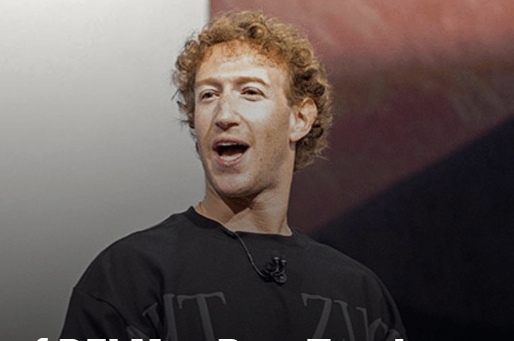
transcript-zuckerburg-announces-major-policy-changes
I started building social media to give people a voice. I gave a speech at Georgetown five years ago about the importance of protecting free expression, and I still believe this today, but a lot has happened over the last several years.
2016 Election
Censorship was not a significant part of the lexicon before 2016. Facebook was founded in 2004 and initially was simply a conduit to share information. Then Hillary Clinton lost the 2016 election and someone needed to be blamed. Facebook became the target for politicians who said Trump’s victory was something sinister; it couldn’t have been the appeal of Trump’s message or Clinton’s decidedly poor performance.
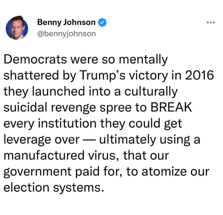
For years, Hillary Clinton searched for answers to explain her loss, blaming voters, her colleagues, everyone but herself. The loss was eventually blamed on Russian bots which had manipulated Facebook to elect Trump. Putin and Trump were supposedly in cahoots and Facebook was the broker for this unholy alliance. We still hear this in media today:
But after the 2016 presidential election, the company and intelligence officials discovered that Russians had used Facebook ads to sow discontent among Americans.
For years, Facebook has been striving to avoid another 2016 election fiasco, when it was used by Russian operatives to spread disinformation and to destabilize the American electorate.
Russian bots likely influenced no more than a handful of voters across the entire country, but Hillary Clinton had finally found the patsy she was looking for:
“You can run the best campaign, you can even become the nominee, and you can have the election stolen from you . . . Social media is still an incredible channel to communicate information that is untrue and defamatory about someone else.
[Americans need to] make sure that the election is not interfered with in that ‘sweeping and systemic’ way that Mueller found it was in the prior election” and how to “protect our candidates from that.”
Clinton allies jumped on the bandwagon. Something needed to be done to curb Facebook: facebook-scrutinized-over-its-role-in-2016-presidential-election
Facebook is in the spotlight for its role in the 2016 presidential election. Facebook has said it would turn over all of its Russian-sponsored ads to Congress.
Facebook was just like Western Union, the post office, or AT&T in prior elections. Still, it was a charge that stuck. Zuckerburg and Facebook sought to restore their reputations by intervening in the 2020 election. Republicans howled at the election chicanery, but it was too late by the time they figured out the game.
Old media was being replaced by on-line social media and Democrats had learned a new game. Manipulating social media was their new secret formula. This success snowballed into more censorship, much at the behest of the Democrat administration during the next four years.
You don’t have to believe my theory, but Mr. Zuckerburg laid much of it out for us in his January 7 tweet.
Facebook’s Questionable Practices: 2020 and beyond
We can take Mr. Zuckerburg at face value; his company has indeed given many people voice, yet they have also stifled the voices of many others. After the 2016 fiasco, they took aim at voices on the other side of the political spectrum.
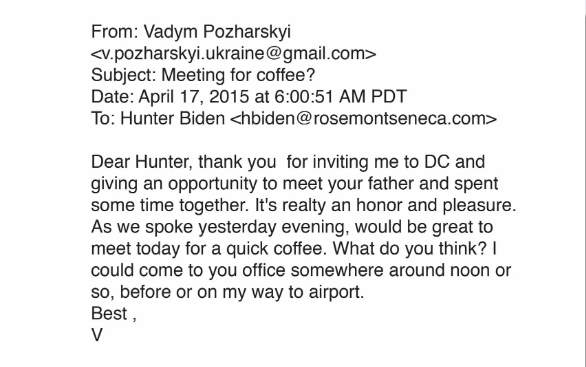
Three weeks prior to the 2020 presidential election, the New York Post broke the story about Hunter Biden’s infamous laptop. NY-Post-Oct-14-Article.
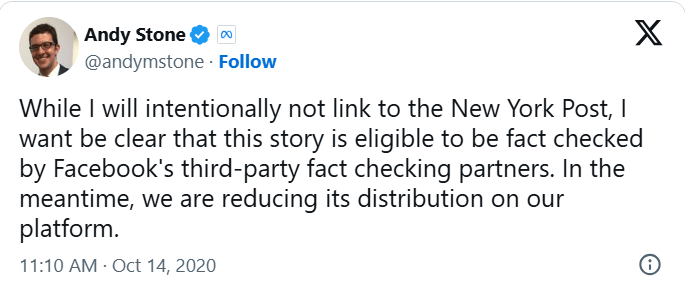
The New York Post article, not surprisingly, garnered much interest. Facebook adamantly refused to allow the article altogether. The most influential social media distributor extant (81% of Americans have a Facebook account today: https://www.omnicoreagency.com/Facebook-statistics/), censored this article at a time when it was pivotal to the election. Twitter, not quite as widely used as Facebook, also blocked the laptop story.
Social media had no legitimate excuse for suppressing a legitimate story (which ultimately proved to be 100% accurate), but these were the new rules of the game. President Biden, at the time, said he had never spoken to his son Hunter regarding business dealings. The laptop proved the president was a liar. Yet, Zuckerburg and others protected Biden from this exposure.
The New York Post, is not a small content creator, but rather one of the largest conservative print media outlets. When had any similarly large media company ever been censored like this? The View spouts nonsense on a regular basis, but they are never censored. Per Zuckerburg, Facebook was being cautious: the story needed to be fact checked first (although thousands of other stories are not fact checked). This singularly unique action has never been adequately explained.
Democrats said the laptop was Russian disinformation, yet a couple years later this phony laptop was the central piece of evidence in Hunter Biden’s own conviction. 51 former intelligence officials called the story Russian disinformation. Their story has not held up over time (because-more-than-50-intelligence-officials-said-so), yet nobody thought it necessary to fact check their stories before dissemination. The whole Russian narrative has been a fraud.
Caution is a legitimate standard but not when used only to protect Democrat Party interests. Facebook took sides during the election and their influence (i.e. their censorship) had a major impact, far more than that of silly Russian bots in 2016. In his post this January, Mr. Zuckerberg himself expressed regret for this incident, and confirmed his critics’ original claims:
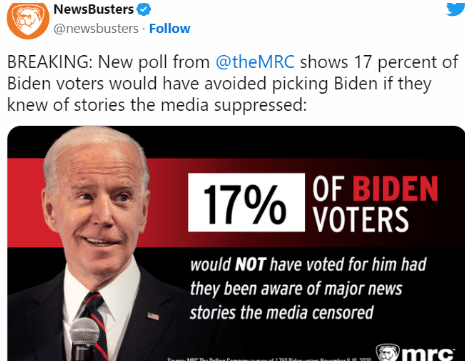
“It’s since been made clear that the reporting was not Russian disinformation, and in retrospect, we shouldn’t have demoted the story.”
How wonderful Mr. Zuckerburg now recognizes the problems with censorship, but has he undergone a genuine conversion or is this an opportunistic ploy? Perhaps he has actual regrets at the mess his company caused. At the same time, it is safe to speak this obvious truth four years after the election ended.
Perhaps this is a temporary change to gain favor with the new administration? Perhaps he recognizes censorship is not so good for business? We can’t yet be certain of his motivation.
Zuckerburg also promoted free speech during the 2019 Georgetown speech he referenced:
“We can continue to stand for free expression, understanding its messiness, but believing that the long journey towards greater progress requires confronting ideas that challenge us. Or we can decide the cost is simply too great. I’m here today because I believe we must continue to stand for free expression.”
Yet, a year afterwards, his company suppressed one of the most significant (and wholly accurate) stories of the presidential campaign. He may be totally genuine, but his judgment is suspect nonetheless.
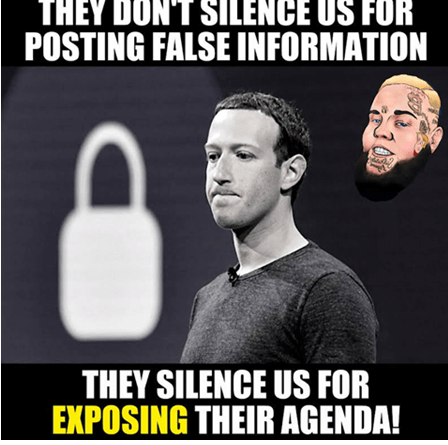
All major social media outlets denied there was election fraud in 2020; they eagerly censored any who claimed otherwise and boasted about doing so.
We need absolute transparency for such an important issue. Let’s hear the facts and determine the truth for ourselves. Don’t withhold the evidence from us because you disagree (or worse, because it serves you or your allies interests). Let those who claim fraud discredit themselves (if you believe them wrong). Truth should be decided through vigorous debate. Where was Mr. Zuckerburg’s defense of free speech while this debate was on-going? In 2025, he splits the baby and makes excuses for his “good faith” effort in 2020:
After Trump first got elected in 2016, the legacy media wrote nonstop about how misinformation was a threat to democracy. We tried in good faith to address those concerns without becoming the arbiters of truth, but the fact-checkers have just been too politically biased and have destroyed more trust than they’ve created, especially in the US.
It wasn’t a good faith effort. Facebook took sides to influence the election.
There are numerous other examples of Facebook’s bias and censorship of folks with primarily conservative viewpoints.
Ben Shapiro during a recent podcast (https://podcasts.apple.com/us/podcast/ep-2111-massive-maga-win-facebook-reverses-its-censorship/id1047335260?i=1000683047743) revealed his personal Facebook page dropped from nearly one billion views per month to 10% of that total. This is not because Shapiro lost popularity; he remains among the most popular podcasters (https://www.edisonresearch.com/the-top-50-podcasts-in-the-u-s-for-q2-2024/).
Facebook deliberately took action to limit Shapiro’s distribution. Why did Facebook consider Shapiro’s opinions dangerous but liberal journalists and podcasters were not scrutinized?

Similarly, Facebook censored opinions regarding Kyle Rittenhouse, the young teenager who because a conservative cause celebre in 2020. For more unknown reasons, Facebook said Rittenhouse cannot be praised on Facebook. The ban was lifted only after Rittenhouse was acquitted, yet the trial and the condemnation of Rittenhouse were the actual injustices. facebook-lifts-ban-on-post-praising-kyle-rittenhouse
Why was it dangerous that Rittenhouse supporters, but not his detractors, be stifled? Supporting Mr. Rittenhouse was not irresponsible. After all, he was eventually acquitted. He was simply defending himself. Facebook again confirmed its liberal bona fides by censoring Rittenhouse advocates.
Mr. Zuckerburg admits now Facebook censored. In fact, he clearly, almost ingenuously, describes the inappropriate pressure government applied to his company:
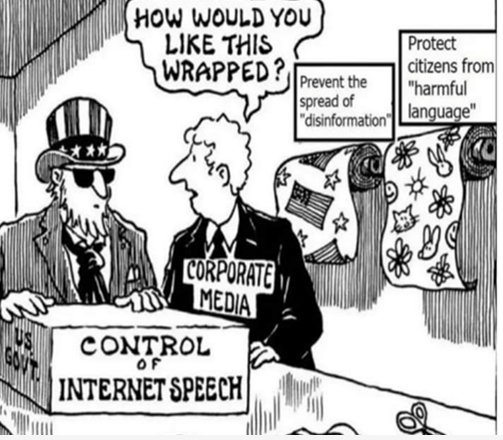
There’s been widespread debate about the potential harms from online content. Governments and legacy media have pushed to censor more and more. A lot of this is clearly political, but there’s also a lot of legitimately bad stuff out there. Drugs, terrorism, child exploitation. These are things that we take very seriously, and I want to make sure that we handle responsibly. So we built a lot of complex systems to moderate content, but the problem with complex systems is they make mistakes even if they accidentally censor just 1% of posts.
That’s millions of people, and we’ve reached a point where it’s just too many mistakes and too much censorship. The recent elections also feel like a cultural tipping point towards, once again, prioritizing speech. So, we’re going to get back to our roots and focus on reducing mistakes, simplifying our policies, and restoring free expression on our platforms. More specifically, here’s what we’re going to do.
This is a major shift for Zuckerburg. In 2020, Senator Josh Hawley questioned Mr. Zuckerburg regarding the company’s censoring algorithms. He was not so candid then. Senator Hawley clearly suspected shenanigans between Facebook and other social media along with government interference in elections. This almost 8-minute clip of the episode can be summed up easily:
Mr Zuckerburg says he did not coordinate censorship policies with Google and Twitter. However, when asked to provide supporting evidence he deferred (refused, essentially). He deferred again when ask to provide a list of web sites Facebook had considered banning along with any information with regard to content moderation at Facebook. All answers were “no” or “I don’t know”.
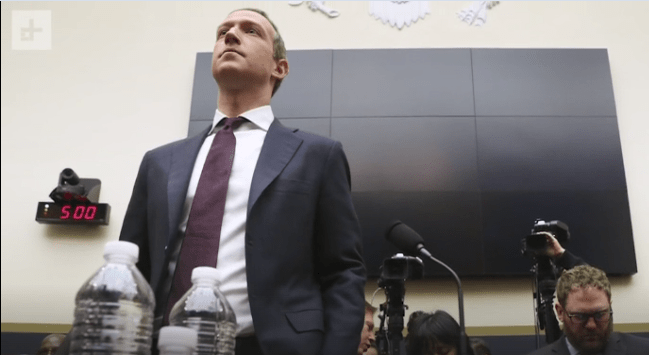
Mr. Zuckerburg is not an effective liar. Hawley must have anticipated the evasive answers he would receive, so he brought the receipts. He asks Mr. Zuckerburg about a Facebook tool called Centra. Zuckerburg said he was not familiar with it. Aw shucks. He is just the head of the company, but the brains of operations must be someone else? Of course, Zuckerburg brought no one else nor does he refer to anyone else during testimony.
The Senator provides specifics regarding Centra’s role in censorship and then asks: How many accounts have been shut down by the use of Centra? Mr. Zuckerburg responds with: “I do not know.” It seems too convenient. Is it possible he did not know and was not involved with the day-to-day operations?
Mr. Zuckerburg claims he has always been committed to free speech, but he had no clue of free speech violations per this testimony. He portrays himself as the company’s policy setter and the man in charge; yet, he knows nothing about the censorship regime in his company? He can’t have it both ways. If he was setting policy, why wasn’t he more forthright in Congressional testimony?

Facebook also disallowed political advertising for a time. Granted, political ads are not so rigorous and are often dubious, but elections are critical to the stability of our democracy. Why does a free speech advocate oppose political speech?
Suppression of political ads provides an advantage to incumbents, those who already have other platforms through which to speak. This is not what we want. Zuckerburg’s company has dabbled too frequently in censorship. Facebook has not been fully committed to “free expression”, as he often claims. Perhaps, these have been errors of judgment or perhaps the company has been influenced by folks on one side of the aisle?
Reversing Course
Have I been a bit too critical of Facebook and Mr. Zuckerburg to this point? Perhaps, he is finally on the right path.
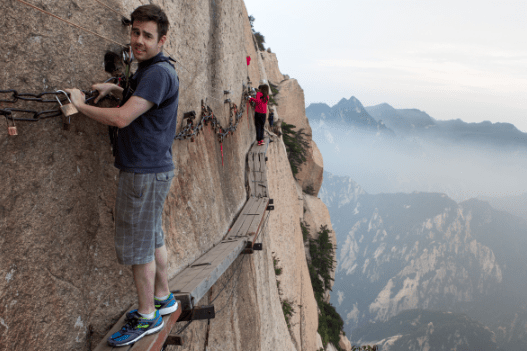
Being a free speech protectionist has been a narrow path recently. Freedom in general is a narrow path that few nations throughout history have ever enjoyed. Many Americans accept the argument we must be protected from lies, disinformation, and misinformation. We are certainly inundated with these nasty untruths like never before. Yes, please protect us from these dangers! Still, the First Amendment is extremely broad; it allows all information, whether truthful or not, to be disseminated. It contains no exceptions or limitations.
Furthermore, the most controversial speech is exactly what the First Amendment was designed for. If everyone agrees on a subject, why do we need the First Amendment? The First Amendment stands because censorship is too easily corrupted. When we protect the public from the perceived dangers of free speech, we create a bigger mess. The First Amendment protects the minority from harm.
Copernicus self-censored his findings until just prior to his death because he knew his discovery would not be well accepted (Galileo suffered the consequences instead). The greatest scientific breakthroughs often come when one lone voice breaks through the consensus. It took many years for Copernicus’s heliocentric theory to be accepted. Einstein too was doubted by many initially. Yet, their examples standout still. Who else that we do not know of has been censored for their unpopular opinions?
Today’s censorship regime is even more sinister. A billion people seek Ben Shapiro’s opinions, yet the vast majority are denied by a few powerful social media outlets. We should be highly skeptical of those exercising that power. They claim to protect us, but they protect their own interests first. Mr. Zuckerburg, to his credit, has recognized these abuses and appears to be seeking entry onto the narrow way.
Early in 2024, Mr. Zuckerburg provided this to Congress regarding censoring of COVID debate: http://timesofindia.indiatimes.com/articleshow/112841766.cms?utm_source=contentofinterest&utm_medium=text&utm_campaign=cppst
“Ultimately, it was our decision whether or not to take content down, and we own our decisions, including COVID-19 related changes we made to our enforcement in wake of this pressure. I believe the government pressure was wrong and I regret we were not more outspoken about it.
“I also think we made some choices that, with the benefit of hindsight and new information we would not make today.”

Government controlled the COVID narrative, pressuring social media companies to echo the government line while censoring commentary of highly credentialed medical critics from prestigious universities and other institutions covid-debate-stifled-do-not-forget. Thank you Mr. Zuckerburg for pulling back the covers:
facebook-pressured-by-biden-admin
“In 2021, senior officials from the Biden Administration, including the White House, repeatedly pressured our teams for months to censor certain COVID-19 content, including humor and satire, and expressed a lot of frustration with our teams when we didn’t agree,” Zuckerberg said.
In his letter to the judiciary committee, Zuckerberg said the pressure he felt in 2021 was “wrong” and he came to “regret” that his company, the parent of Facebook and Instagram, was not more outspoken. Zuckerberg added that with the “benefit of hindsight and new information” there were decisions made in 2021 that wouldn’t be made today.
Zuckerburg also acknowledges fact checkers are not so good. Yes, of course. Fact checkers are as prone to mistakes and political bias as anyone else.
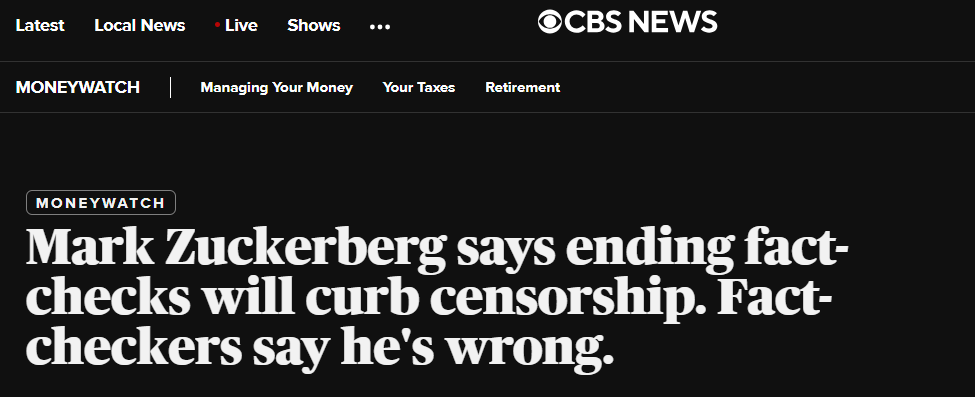
First, we’re going to get rid of fact-checkers and replace them with community notes similar to X starting in the US. . . . the fact-checkers have just been too politically biased and have destroyed more trust than they’ve created, especially in the US. So, over the next couple of months, we’re going to phase in a more comprehensive community notes system.
Not surprisingly, fact checkers ruled this comment false. Go figure.
Mr. Zuckerburg continued with more good stuff:
Second, we’re going to simplify our content policies and get rid of a bunch of restrictions on topics like immigration and gender that are just out of touch with mainstream discourse. What started as a movement to be more inclusive has increasingly been used to shut down opinions and shut out people with different ideas, and it’s gone too far. So, I want to make sure that people can share their beliefs and experiences on our platforms.
Third, we’re changing how we enforce our policies to reduce the mistakes that account for the vast majority of censorship on our platforms. We used to have filters that scanned for any policy violation. Now, we’re going to focus those filters on tackling illegal and high-severity violations, and for lower-severity violations, we’re going to rely on someone reporting an issue before we take action. The problem is that the filters make mistakes, and they take down a lot of content that they shouldn’t. So, by dialing them back, we’re going to dramatically reduce the amount of censorship on our platforms. We’re also going to tune our content filters to require much higher confidence before taking down content. The reality is that this is a trade-off. It means we’re going to catch less bad stuff, but we’ll also reduce the number of innocent people’s posts and accounts that we accidentally take down.
Mr. Zuckerburg adds a fourth, fifth, and sixth change, but he said enough already to demonstrate his understanding.
Fact checkers, content moderation, and other new euphemisms for censorship were introduced to distract us from the true nature of censorship regime. Elon Musk began the reversal of censorship with Twitter two years ago. Now, Zuckerburg is hitching his star to this wagon. Good for him.
Mr. Zuckerburg ends with the following:
We have the opportunity to restore free expression, and I’m excited to take it. It’ll take time to get this right, and these are complex systems. They’re never going to be perfect. There’s also a lot of illegal stuff that we still need to work very hard to remove. But the bottom line is that after years of having our content moderation work focused primarily on removing content, it is time to focus on reducing mistakes, simplifying our systems, and getting back to our roots about giving people voice. I’m looking forward to this next chapter. Stay good out there, and more to come soon.
I am in a wait and see mode regarding this re-commitment to free speech. Hopefully, there is more action to follow.
Dave https://seek-the-truth.com/about/
https://seek-the-truth.com/
https://seek-the-truth.com/category/covid/
https://seek-the-truth.com/category/elections/
 Seek the Truth