President Trump has moved with alacrity to eliminate inefficiencies and corruption in government. Even before Inauguration Day, the Department of Government Efficiency (DOGE) was being staffed so they could start cutting day one.
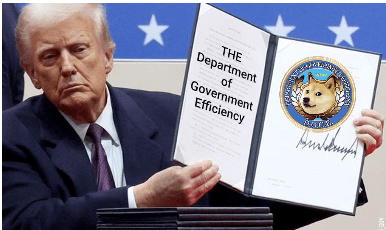
dogegov.com: Our mission is to decentralize the narrative around government spending, giving power back to the people to hold government entities accountable for their financial decisions . . . Together, we will navigate towards a future where government efficiency is not just a goal but a standard.
Of course, every president talks about eliminating “waste, fraud, and abuse” in government. It is very popular with constituents. Two months into his presidency, President Bill Clinton created an agency similar to DOGE:
wikipedia-partnership-for-reinventing-government
The National Partnership for Reinventing Government (NPR) was a U.S. government reform initiative launched in 1993 by Vice President Al Gore. Its goal was to make the federal government “work better, cost less, and get results Americans care about”.[1] The initiative aimed to streamline processes, cut bureaucracy (with a focus on overhead costs beyond issues addressable by statute), and implement innovative solutions.
Vice President Al Gore led this effort, awarding “golden hammers” for government employees who improved efficiency: 1997-2001.state.gov/about_state/people/hammer

The Hammer Awards are Vice President Gore’s special recognition for teams of federal workers who made important contributions to reinventing a piece of the United States Government. The goals of that program, which I’m sure you all know well, are: Putting Customers First, Cutting Red Tape, Empowering Employees, and Getting Back To Basics.
I know first hand the lack of efficiency in the federal workforce having served in various capacities for almost 42 years. Jimmy Carter was president when I enlisted in the military in 1979 and Ronald Reagan was leaving office when I joined the federal government in 1988.
President Trump’s Reduction In Force (RIF) program will be the third during my government career. There was a purge of ten-percent of lowest performers from all military branches (1982) while I served (there were corresponding cuts in the federal workforce as well). A few years later came the Clinton RIF conducted in conjunction with re-inventing government effort. President Clinton purged 377,-000 federal jobs during his eight years:
reinvention-remembered-a-look-back-at-seven-years
The result was a report detailing 1,250 specific actions intended to improve government operations and trim $108 billion from the federal budget. Among the report’s recommendations were proposals to privatize the Federal Aviation Administration and cut 252,000 jobs from the federal workforce. Ultimately 377,000 federal jobs were cut.
A few years later, another Democrat president emphasized the importance of spending cuts:
obamawhitehouse.archives.gov/node/74365
Instead of accepting the status quo, President Obama has worked from day one to change how business is done in Washington. Under his direction, the Administration has moved to eliminate wasteful spending, streamline what works, and modernize how government operates to save money and improve performance.
From scaling back on no-bid contracts and stopping improper payments to getting rid of unneeded Federal real estate and ending out-of-control information technology (IT) projects, the Administration has worked to reform how Washington spends taxpayer dollars. We’ve focused on cutting spending that is wasteful, duplicative, and outdated and improving the way services are delivered to the American people.
President Bush attempted to reform out-of-control Social Security spending. He was stymied in this effort (and ruthlessly demagogued). Ultimately, 9/11/2001 altered the trajectory of his administration and he never seriously raised the issue again.
Defining Problems
From within my organization, numerous problems are apparent. I have attempted to address many, but it is unbelievably difficult to first convince others above you of the existence of problems, and then, if you do, to motivate them to take action. The bigger problems are simply accepted as unchangeable. So, rank-and-file staff become adept at adapting and working around hindrances that should not even exist.
Government certainly has far too many employees, far too many layers, far too many departments. It has always been difficult to fire unproductive employees or eliminate unneeded departments. Non-performers can make a career with the government; their colleagues carry more of the workload to make up for these slackers. To exacerbate problems, government unions often stand up for the poor performers when they are targeted by management (unions reflexively align with employees against management).
Many conscientious and skilled folks are stuck in jobs with little value, perhaps in jobs that once had value. There is little incentive to cut these jobs because these colleagues may be friends or there is great empathy for those supporting families. When moved to meaningful jobs, they generally flourish. However, reorganizations are unpopular (change is difficult) or burdensome due to excessive (and often ridiculous) guidelines. So, potentially productive employees flounder in unneeded jobs.

Rank-and-file employees recognize problems, but little change is attempted. Upwardly mobile folks would rather not stick their heads up and advocate for substantial change. They often prefer “quick wins”. Government is also burdened with numerous layers of management; our agency has a plethora of executives, seven layers of management in all. Because so many are in leadership, relatively few have real power (or are unwilling to exercise power) to affect organizational change. So, instead the system is blamed.
The most ambitious, but not necessarily the best, enter management. Employees well suited for management see the difficulties managers endure, and sensibly avoid that hassle. Employees should be incentivized to enter management; more competition for fewer jobs will yield better leaders.
Furthermore, far too many executives have little understanding of their subordinates’ jobs. My father explained this long ago; it has only become worse since his day:

“That’s the one thing about the military that’s different than civil service. Everyone from the Chief of Staff on down has to do their share of grunt work. Nobody moves up without it, and nobody can avoid it for long. You might have a cushy job in Washington for a while, but they won’t let you stay there . . . Even generals have to jump out of airplanes from time to time. On the other hand, a civil servant might spend his entire career in Washington, insulated from the real world . . . Can’t do that in the army.”
In my branch, Information Technology (IT), the technical staff are the lifeblood: program developers, technical analysts, systems administrators, database administrators, etc., yet the ratio of technical staff to non-technical staff has steadily decreased throughout my tenure. We have far too many overseeing and directing technical folks who do the real grunt work. New departments are created to “assist” technical staff, but they become more of a burden than anything. These “helpers” rarely answer technical questions posed by program development or technical administrative staffs. They have almost no ability to solve structural problems. They demand we fill out their spreadsheets to help them track our programs. My dad would have said: they don’t know what it is like to sleep in foxholes, clean a rifle, jump out of an airplane, eat and shave out of your helmet, etc. They ask questions and attempt to boss us around, but any fool can do that; that’s not how things get done.
Our team often encounters roadblocks finding assistance for system problems becuase we have navigate the organization’s labyrinthian structure. “Not my department,” is a common refrain. “Not sure who does that.” Even within the right department, many folks know just one small aspect of the job and can’t assist. We are re-routed to the few on those teams who actually get things done.
Many government departments serve legitimate, often critical functions, but there are far too many regulations which hamper productive employees. Take the shackles off government employees and the nation will instantly get a better product. Our team does critical work, but we operate with twenty-five pound ankle weights. For instance, when I last hired employees, I was not allowed to conduct interviews. Resumes were the only input provided. Are you kidding me? How can I hire the best employees with limited information? I should talk to these people before hiring them. I wound up hiring folks recommended by colleagues, friends, or family. At least, I knew something of their character, knew they would not be disruptive influences, before hiring them.
We can all look around and see government fraud exposed by media, sometimes on a massive scale. social-security-fraud-what-it-is-costing
Social Security fraud statistics can be difficult to pin down. Some are grouped inside a larger category that the Social Security Administration (SSA) calls “improper payments,” which includes everything from innocent mistakes to willful fraud. The SSA estimates that it made about $13.6 billion worth of improper payments during the 2022 fiscal year.
Elon Musk claims to have found even more already:
musk-outlines-super-obvious-changes
“It is ridiculous that these changes didn’t exist already! Yesterday, I was told that there are currently over $100B/year of entitlements payments to individuals with no SSN or even a temporary ID number,” he continued. “If accurate, this is extremely suspicious. When I asked if anyone at Treasury had a rough guess for what percentage of that number is unequivocal and obvious fraud, the consensus in the room was about half, so $50B/year or $1B/week!! This is utterly insane and must be addressed immediately.”
He should continue poking around.

In addition, many taxpayers do not pay their fair share, hiding much or all of their income. Those of us who pay our “fair share”, assume the burden for those who do not:
irs-one-trillion-taxes-uncollected-annually
The amount of taxes going uncollected by the federal government could be as much as $1 trillion or more per year, IRS Commissioner Chuck Rettig said Tuesday.
Surely, we can do better.
Solving Problems
The problems are real and have been acknowledged by every president in my lifetime. We certainly should not scream “constitutional crisis” when President Trump focuses his aim on something all his predecessors labeled problematic.
nadler-we-are-in-a-constitutional-crisis
There can be no higher stakes than this attempt to arrogate all power to the executive branch away from Congress, and more important away from the American people. We’ve talked for a long time about approaching a constitutional crisis. We are now in it. We are now in a constitutional crisis. Representative Jerry Nadler (and colleagues), February 11, 2025.

Ignoring a $36+ trillion dollar debt, one which has accelerated the last twenty-five years has been the real constitutional crisis. In fact, our leaders should feel morally obligated to resolve this problem. I am appalled so few legislators have even talked about it, much less taken action. Spending money gives them power. Cutting spending reduces their power. That is the end of the conversation, I suppose. Still, we cannot continue to function as a nation if debt continues to grow without bound. Hopefully, real change will come this time around.
The crisis for Representative Nadler and other Democrats is targeting the bureaucracy which has advanced many of the Democrat Party goals while Republican presidents were in office. It wasn’t a crisis when folks were given golden hammers for smashing silly regulations and innovating processes. It wasn’t a crisis when Presidents Obama and Biden spoke of wasteful spending. Why should it be a crisis now?

Golden hammers were cute and perhaps even effective at chipping away at waste, but that effort did not effectively alter the trajectory in the years following.
President Bush was on the right track targeting Social Security; today it is the single largest budget item https://usafacts.org/articles/the-federal-budget-an-overview/. If Social Security had been privatized in 2001, and portfolios invested in a Dow Jones index fund, Social Security would be solvent for years to come and recipients far better off. The Dow Jones rose from 15,000 to nearly 45,000 in the 24 years since Bush’s original proposal. However, Bush was not allowed to continue.

There are many forces, within and outside government, working against reformers with good ideas. President Bush (and later Speaker Paul Ryan) was demagogued for “throwing grandma off a cliff”. Politicians all know Social Security is becoming insolvent, but they hesitate to act after seeing this treatment.

Presidents Obama and Biden paid lip service to cutting waste, fraud, and abuse. President Trump too failed to address spending problems in his first term, perhaps, in part, because the resistance from within the government itself. Government workers protect their own interests (foremost to keep their jobs and maintain their fiefdoms) and ignore the reformers. More than fifty years ago, my father explained how the typical bureaucrat deals with zealous reformers:

Like most soldiers, my father doesn’t hold bureaucrats in high esteem, but he does admire their talent for survival. “You always have these people who come into Washington saying they are going to change things, get rid of the bureaucracy, cut the waste, fraud, and abuse. The bureaucrat has heard it all before, so he just hunkers down for a while and pretty soon, your reformer is voted out of office or is promoted or moves on for greener pastures, and the bureaucrat is back to doing things the way he’s always done them . . . The bureaucrat makes sure nothing ever changes in Washington. He drives you crazy, but you at least have to admire his ability to survive . . .
Doing it Right
President Trump recognizes the current problem must be addressed quickly and decisively. Still, it shouldn’t bee too quickly; the solution needs some precision. While many government operations add little value, others are critical. Cutting key programs and key employees without careful consideration, could cause a good deal of pain.
The Trump Administration is just getting started. It is far too soon to judge their progress, but it is definitely not a “constitutional crisis”. Instead, this is perhaps the most significant and critical reform instituted in my memory.
Diversity, Equity, and Inclusion (DEI) offices were eliminated immediately. That’s a good move; these organizations are more aligned with Non-diversity, Inequality, and Exclusion than what they purported to be dei-dystopia.
Many jobs will soon be eliminated by folks voluntarily taking a nice severance package:
Fork in the Road Goes Ahead as Agencies Told to Prep for Layoffs — FEDagent
The Trump Administration officially closed the deferred resignation offer for federal employees, after a federal judge in Massachusetts lifted his earlier hold on the program.
Immediately after the decision from federal judge George O’Toole, the Office of Personnel Management (OPM) announced that the program was closed, and about 77,000 federal employees accepted the deferred resignation offer. That amounts to less than four percent of the federal workforce, short of the administration’s five to ten percent goal.
The president promises more reduction in force. Other presidents dawdled and ran out of time. Trump is not making that mistake, and is moving very quickly. Still, the administration needs logical criteria for subsequent changes. They can arbitrarily cut employees across all departments, or they can use a factor like “time in service” to determine who goes first. A merit based (keep the best employees) and need based (keep the most essential operations) formula is better.

Former General Electric (GE) CEO Jack Welch developed the following paradigm:
jack-welch-fire-the-bottom-ten-percent
According to Welch a company will broadly have 20% A players, 70% B players and 10% C players.
A players are people who are filled with passion, committed to making things happen, open to new ideas from anywhere, and blessed with lots of runaway ahead of them. They have the ability to energise not only themselves, but everyone who comes in contact with them. They make business productive and fun at the same time.
The B players are the heart of the company and are critical to its operational success. We devote lots of energy towards improving Bs. We want them to search every day for what they’re missing to become As. The manager’s job is to help them get there.
The C player is someone who can’t get the job done. Cs are likely to enervate rather than energise. They procrastinate rather than deliver.
Trump and Musk cannot make all decisions from their level; they need to free government organizations to remove those C players they already know are unproductive. In addition, the reorganization should:
- carefully determine the departments needed. Emphasize keeping and supporting rank-and-file folks doing the essential work of each organization. DEI departments add nothing to the bottom line of corporations or government agencies. That was an easy call. Some precision is needed for remaining cuts.
- eliminate layers of management. Streamline organizations, so each manager and executive has more authority and can reach upper levels of the organization more easily. Make it more attractive for qualified employees to enter management as well, and promote more from within the rank-and-file.
- cut regulations. Allow employees with the “know how” to innovate and do the jobs they were hired to do. Quit hamstringing them with silly rules. Government employees often know the problems which need fixing; empower them to fix them.
- make it easier to fire employees (although do not eliminate all protections) and make it easier to hire good people to replenish staff lost through attrition or needed due to increased demands.
- eliminate government unions. Employees think unions work for their interests, but they are generally counter-productive. Furthermore, union officials are paid on the government dime to do work not essential to the organization’s mission.

Thus far, I am supportive of the government restructuring effort. The problems are real and have been building for decades. However, I withhold judgment until I see the results. It is far too early to tell. I pray the pressure to move quickly will be balanced with getting it right, and not result in government agencies being unable to complete their most essential functions.
If cuts are based on performance and need, the effort will likely succeed. If decisions are made on any other basis, problems will result, the effort will backfire, and the opportunity to fix government will be lost. Let’s get this right. This matters as much as anything attempted in a long time.
Dave https://seek-the-truth.com/about/
https://seek-the-truth.com
 Seek the Truth
One thought on “Golden Hammer or Constitutional Crisis (An Insider’s View)?”