The Supreme Court established the principle of judicial review more than 200 years ago (via Marbury vs. Madison, 1803). This previously undiscovered principle expanded the power of the Judicial Branch dramatically, arguably beyond what was originally intended. The Supreme Court retained this power thereafter. Then about sixty years ago, the judiciary’s power expanded further as they discovered another amazing power, the power of injunctions. Injunctions became a more accessible political tool, one that more of the judiciary could use to halt actions of the Executive and Legislative branches.
Injunctions were issued sparingly initially, but have become problematic recently as more judges flex their muscles. This judiciary superpower is not reserved to the Supreme Court. Today, District Courts, courts with limited geographical jurisdiction are influencing the whole nation and encroaching on the enumerated powers of the other two branches. If you cannot stop your political opponent any other way, appeal to your ally in the judiciary.
Throughout our history, Americans have accepted the authority of the highest court’s decisions, even controversial decisions impacting the whole nation, even decisions they vehemently disagreed with. From the Dred Scott decision prior to the Civil War to Roe v. Wade and legalization of abortion to Obergefell and the legalization of gay marriage, the court has dramatically impacted the nation as a whole. In response, we have always sought legal remedies to counter these decisions: there has been considerable debate in Congress and the nation as a whole, countless books have been written, countless political speeches given, much demagoguery uttered, much political strategy employed, etc. Whether or not the Supreme Court, a mere nine justices, should decide the fate of such consequential matters and be a proxy for the electorate as a whole, is a topic in itself for debate. Still, the nation has tolerated the court’s impactful decisions (until overturned as in the first two cases noted above).
We accepted this paradigm because we respected the Constitution and recognized the authority given the Supreme Court (although judicial review is not specifically mentioned in the Constitution), but the authority of the lower courts does not come from the Constitution at all; the legislature established these courts. Today, we recognize the lower courts importance and utility, but we do not have to tolerate them when they trespass far beyond their original bounds, and increasingly encroach on the political sphere. We do not have to accept them exactly as they are today. They are not immutable. Maybe we are happy with a decision today, but eventually they run afoul of our politics. Their continued usurpation of power will ultimately become a problem for each of us.

How far will judiciary power expand and how many judges will gladly exercise these newly discovered wonderful powers before Americans say enough is enough? It is dubious these court issued injunctions are even legal in themselves, so how do we rein in a judiciary which does not recognize its own limits and is itself outside the law?
Certainly, we can point to many examples throughout world history where judiciaries have run amok. We don’t want our judiciary to get out-of-control like has happened in other civilizations: the judiciary should not be too involved in politics and seeking the favor of political leaders; they should not use legal means to enforce illegal and immoral judgments; they should not misuse power or usurp power meant for others.
Right now, Judge Boasberg [or fill-in-the-blank judge issuing unilateral injunctions] is the most powerful man in America. He is controlling the national security policy of the United States. victor-davis-hansen-on-levin
America’s judiciary has failed us at times in the past, but we have eventually found solutions to restore the balance. Today, another leveling of the playing field is needed, but how do we effectuate change while still living within the bounds of our Constitutional system?
The Courts get Political
There was significant debate regarding the power of the three branches initially. In the Federalist Papers, Alexander Hamilton defended concerns raised regarding the judiciary, saying it would be the weakest of the three branches. Per Hamilton, the judiciary was never intended to have the final say on so many decisions as it does today:
Whoever attentively considers the different departments of power must perceive, that, in a government in which they are separated from each other, the judiciary, from the nature of its functions, will always be the least dangerous to the political rights of the Constitution; because it will be least in a capacity to annoy or injure them. The Executive not only dispenses the honors, but holds the sword of the community. The legislature not only commands the purse, but prescribes the rules by which the duties and rights of every citizen are to be regulated. The judiciary, on the contrary, has no influence over either the sword or the purse; no direction either of the strength or of the wealth of the society; and can take no active resolution whatever. It may truly be said to have neither FORCE nor WILL, but merely judgment; and must ultimately depend upon the aid of the executive arm even for the efficacy of its judgments. Alexander Hamilton, Federalist No. 78
250 years ago, Alexander Hamilton kept the judiciary within its lane. Today, we have Justice Clarence Thomas who properly understands the limited role of the judiciary. Last month, during oral arguments for Trump v. CASA, Washington, and New Jersey (addressing the president’s executive order ending birthright citizenship for non-citizens), Justice Thomas asked a subtle but chocked full question regarding injunctions.
US SOLICTOR GENERAL, JOHN SAUER: “We believe that the best reading of that is what you said in Trump against Hawaii, which is that Wirtz in 1963 was really the first universal injunction. There’s a dispute about Perkins against Lukens Oil going back to 1940. And of course, we point to the Court’s opinion that reversed that universal injunction issued by the D.C. Circuit and said it’s profoundly wrong.”
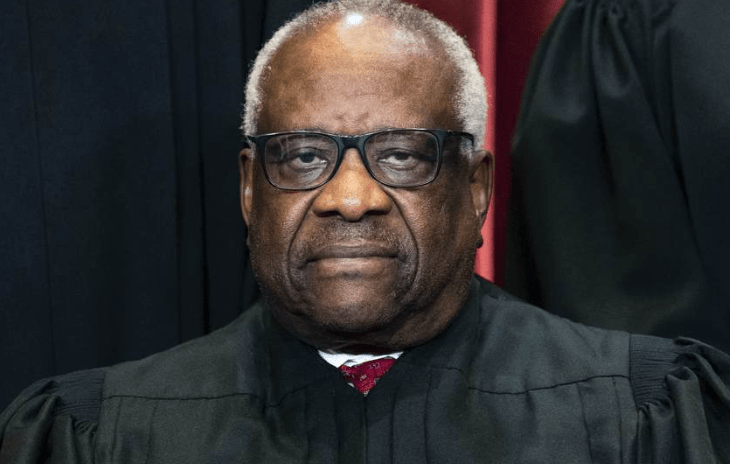
JUSTICE THOMAS: “So we survived until the 1960s without universal injunction?”
SAUER: “That’s exactly correct. And in fact, those were very limited, very rare, even in the 1960s. It really exploded in 2007.”
Justice Thomas asks the right question regarding injunctions; however, the answer he was provided doesn’t fully reveal the whole story.
Every administration has been impacted by injunctions, but The Trump administration has been affected far more than any other administration. This is not by chance. The increase in injunctions came gradually and then all of a sudden when Trump made his political debut.

“How did you go bankrupt?” Bill asked.
“Two ways,” Mike said. “Gradually and then suddenly.” Ernest Hemmingway, The Sun Also Rises
The political strategy to inhibit the current administration’s ability to govern and implement policy voted for by the electorate is: find judges openly aligned to your political viewpoint and file lawsuits in their courts. In addition, avoid judges whose politics don’t align with your own. Your chances of a political win increase dramatically. It has become a new way to govern.
Of course, that strategy doesn’t always work, but it works enough to make a significant difference. Democrats appear to have perfected the strategy while Republicans try to catch up.

There seems to be general agreement for 1963 being the starting point for nationwide injunctions: https://www.foxnews.com/politics/number-injunctions-halting-trump-policies-trounces-predecessors-double.
From 1963 until 2024 there were 127 nationwide injunctions, on average two per year. These numbers might lead one to conclude the courts have restrained themselves, but dig deeper and something more sinister is revealed:
- From 1963 to 2000, only 31 nationwide injunctions were issued, slightly less than one per year (.82/year).
- From 2001 to 2016, during the Bush and Obama administrations, there were 18 more, just slightly more than one per year, the beginning of an ever-so-slight increase (1.12/year).
- The real “explosion” began in 2017 with the first Trump Administration. There were 64 injunctions during those four years, an average of 16 per year.
- The numbers fell again during the four years of the Biden Administration, falling to 3.5 per year. Still, this number is far higher than the one per year limit established last century.
- During the first four months of the second Trump Administration, there have been 25 nationwide injunctions. That’s a rate of 75 per year https://www.congress.gov/crs-product/R48476. Holy cow!

The pattern should be clear: roughly 50 injunctions issued for a 54 year period (1963-2016), and 100 more injunctions the last nine years (2017-2025).
Half of ALL nationwide injunctions issued during the 62-year period from 1963 to 2024 were directed against the first Trump administration. The pace has increased even more dramatically in 2025. There could be more injunctions issued this year and next than the combined total of all prior years. The possibilities for new injunctions are endless.
Many just blame the situation on Trump without considering what is truly happening. Why were the 11 other administrations during this period not targeted in the same fashion as the Trump Administration? Is the Trump administration flouting the law? Does it need to be reined in or is this a strategy designed to limit the effectiveness of the administration and deny voters the government they selected?
What is so Crazy about these Laws?
Here are some of the 25 “controversial” executive orders or presidential actions which have been challenged just this year https://www.congress.gov/crs-product/R48476
- Exec. Order No, 14,160, Protecting the Meaning and Value of American Citizenship (there have been three injunctions impacting this one order)
- Exec. Order No. 14,183, Prioritizing Military Excellence and Readiness
- The removal of non-citizens to countries not included on their removal orders without notice and an opportunity to contest the removal.
- Exec. Order No. 14,248, Preserving and Protecting the Integrity of American Elections
- Exec. Order No. 14,168, Defending Women from Gender Ideology Extremism and Restoring Biological Truth to the Federal Government, and Exec. Order No, 14,187, Protecting Children from Chemical and Surgical Mutilation
- Termination of certain funding awards by the Department of Education, Housing and Urban Development, and numerous other executive orders pausing or curtailing federal spending.
These are not matters outside of the president’s purview. Furthermore, why do lower courts consider them within their own purview? What authority gives the Southern District of New York, for instance, the power to halt nationwide policies to curb federal spending, to strengthen the military, to protect women and children from suspect medical practices, to define citizenship, to control our national borders?
Even if you consider the president’s judgment is wrong in these instances, you should acknowledge voters gave him the power to enact these orders. If he goes too far, voters have the opportunity to rebuke him during the next election. A new executive or a new legislature will then rollback the excesses. That’s how the system should work.

Instead, District and Appellate Court judges have assumed roles they were never authorized to have.
The Supreme Court has long been recognized as an authority to decide national issues, but even they have tended to steer clear of encroaching on powers reserved for the other two branches of government. However, today’s unknown activist lower court judges increasingly seek to play Supreme Court Justice for a day (to be hero for a day), so they can stop the president from implementing national policy they (and their political allies) dislike.
Frankly, many important issues should even not be decided by even nine individuals. Abortion, gay marriage, and other hot button issues were being decided by voters state by state until the nine justices intervened. Who should decide these matters: millions of voters in each state or nine justices? Americans have failed in our civic duty by allowing judges such far reaching power, so we should not be surprised when more judges seize power in more instances. We should have stopped them years ago, but even still, now is a good time to act.
Behold, now is a very acceptable time; behold, now is the day of salvation. 2 Corinthians 6:2
Of course, groundbreaking decisions on abortion, gay marriage, and runaway slaves are extremely rare, so one could say the courts do not overstep their bounds often. Furthermore, the lower courts certainly handle a plethora of sticky problems, providing services which benefit society as a whole, and we all want to support justice, law and order so we give the courts their due. Still, they have exceeded their bounds and they must be called out.

The primary problem is the accountability of these judges. One single judge (or perhaps two of three appeals court judges) can decide they know better than the president and the voters, and unless that case makes it to the Supreme Court, there is nobody stop them. At least, the Supreme Court has nine justices, so five justices must agree. We hope there are enough sane thinkers on the high court to outweigh one or two misguided justices. Furthermore, we voters have some (limited) influence on the Supreme Court as we vote for the president who appoints justices. However, few voters elect District Court judges (or for political leaders who may appoint them). A single judge elected in Pennsylvania may make a decision affecting me in North Carolina (or even the nation as a whole). Voters outside of Pennsylvania have no effective way of holding Pennsylvania judges accountable; we do not know their names or their backgrounds; they do not live in our communities. They are solar flares, making headlines for a day and leaving behind a lasting impression (often negative) long after we have forgotten them completely. What stops these judges from deciding matters well outside their strike zone? Many of us are outraged at their brazenness, but if their decisions benefit their political allies (in government and in media), they may even be provided the cover they need regardless of the suspect process.
A single judge should not override the judgment of so many voters, voters the judge is not accountable to. Voters trusted President Trump to make decisions, yet, this year, on average, one judge per week overrules him. The voters selected their executives and their legislatures to implement policies they prefer. If their elected officials overstep their bounds or break their promises, they (or their party) will be rejected in the next election. We do not need the lower court judges to be the political counter-balance. We need judges, protected by political allies, to be held accountable.
Jefferson Limits the Courts
A president usurping the judiciary or acting outside the law is a problem as we have been told repeatedly regarding President Trump.
“And democracy is at risk. Look, Donald Trump is a lawless, angry man. He thinks he should be king. He thinks he should do whatever he wants, regardless of the law, and he thinks judges should just listen to him.” Senator Schumer on Meet the Press, March 20, 2025
Without discussing the merits of this comment, let’s acknowledge a lawless president, overstepping his bounds, is definitely a risk, but is it not an equally grave risk when a judiciary usurps its own power and infringes upon the other two branches? President Trump’s power has clearly be limited by the courts this year. He has not overstepped his bounds, especially since he has been hampered at every step. The problem, however, is taht these restrictions have not been applied appropriately.
Luckily, the other two branches have power which can even the scales yet again. Alexander Hamilton said the courts were subject to oversight; they too should not “be above the law”:
According to the plan of the convention, all judges who may be appointed by the United States are to hold their offices DURING GOOD BEHAVIOR; which is conformable to the most approved of the State constitutions and among the rest, to that of this State. Its propriety having been drawn into question by the adversaries of that plan, is no light symptom of the rage for objection, which disorders their imaginations and judgments. The standard of good behavior for the continuance in office of the judicial magistracy, is certainly one of the most valuable of the modern improvements in the practice of government.
This simple view of the matter suggests several important consequences. It proves incontestably, that the judiciary is beyond comparison the weakest of the three departments of power1; that it can never attack with success either of the other two. Federalist No. 78
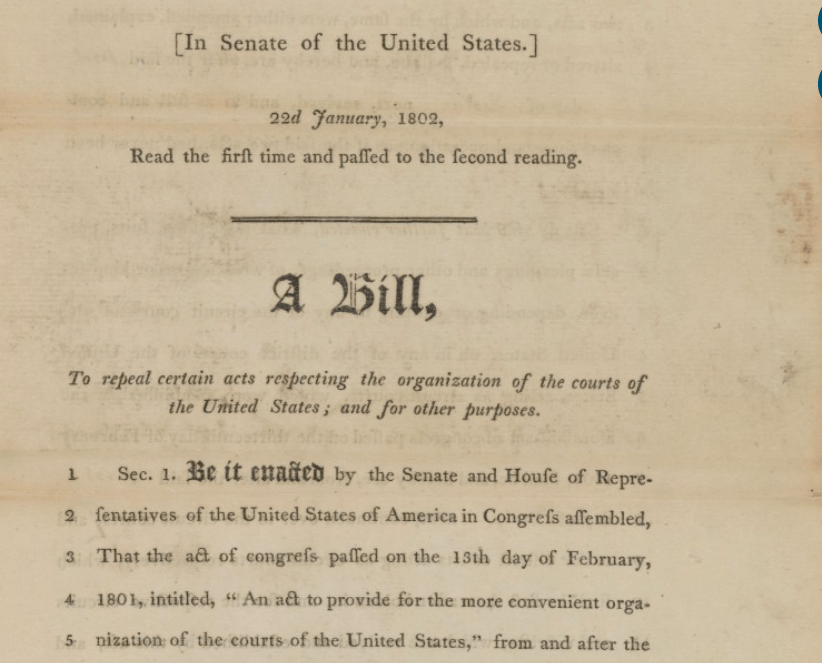
Thomas Jefferson recognized this problem long before it turned into the quagmire it is today. Just before he assumed office in March 1801, the prior administration created sixteen new federal circuit courts. The following year, Jefferson and the new Congress eliminated those courts. The Jefferson Administration wanted to avoid a poison pill from its political opponents, so after abolishing the prior administration’s courts, they created additional courts, redefining their jurisdiction along terms which better suited their philosophy. This strategy should be considered again today.
Except for the Supreme Court, all courts have been created by the Legislative Branch as was done in 1801 and many times since. Since the courts were created by the legislature and their jurisdiction defined by the legislature, the legislature is also authorized to remove any such courts or to re-define their jurisdiction.

Rogue judges, living outside their legislatively defined lane, should recognize they can be removed, their power curbed, or their authority delegated to another entity. With such a credible threat, judges may become more circumspect. Let’s remind our courts that they cannot act with impunity. Let’s remind the rule enforcers to follow the rules themselves (or suffer consequences).
The solution can be this simple, and there is precedence for it. It is clearly legal and within the bounds of the Constitution; although, as with all such decisions, the political will may not be so easily forthcoming. Thomas Jefferson, one of our most transformative presidents, showed us the way. Democracy survived his shuffling of the judiciary. It will survive another re-shuffling today. The choice is still open to us, so let’s consider it seriously. Let’s put the judiciary back into its box while still allowing it to perform the many vital functions it regularly does. Let’s allow another transformative president, President Trump, to transform the nation as he was elected to do.
Update 7/2/2025:
The Supreme Court recently ruled In the case regarding birthright citizenship, Trump v. CASA, Washington, and New Jersey. The matter at hand, the legality of birthright citizenship is not yet decided, but the court made a significant statement regarding injunctions. In this decision, they referenced several lower court injunctions regarding the birthright case:
birthright-citizenship-ruling-june-27-2025
In each case, the District Court entered a “universal injunction”—an injunction barring executive officials from applying the Executive Order to anyone, not just the plaintiffs . . . the issue the Court decides is whether, under the Judiciary Act of 1789, federal
courts have equitable authority to issue universal injunctions.

In a 6-3 decision, the court provided the clarity needed on injunctions ruling that the lower courts exceeded their authority when issuing nationwide injunctions:
Held: Universal injunctions likely exceed the equitable authority that Congress has given to federal courts.
The power of the Supreme Court comes from the Constitution, and the Supreme Court can rule broadly, but the power of lower courts comes from Congress, and is not nearly as broad.
The issuance of a universal injunction can be justified only as an exercise of equitable authority, yet Congress has granted federal courts no such power.
The American public should not have been forced to wait sixty years for the Supreme Court to rule on this matter. Congress still needs to act regarding district court overreach, and this decision gives them further justification. Congress gave the lower courts power and Congress can take away that power when it is exceeded.

One-channel media will continue to warn us of the Trump Administration, yet the court addressed the concern of a potentially out-of-control executive (i.e. the Trump Administration) versus an out-of-control judiciary. The court’s ruling referenced one of the most famous judicial decisions, the decision which itself set the limits of judiciary power more than 200 years ago. They had no criticism for the Executive in this matter but did upbraid the lower courts for their actions:
No one disputes that the Executive has a duty to follow the law. But the Judiciary does not have unbridled authority to enforce this obligation—in fact, sometimes the law prohibits the Judiciary from doing so. See, e.g., Marbury v. Madison, 1 Cranch 137 (1803) (concluding that James Madison had violated the law but holding that the Court lacked jurisdiction to issue a writ of mandamus ordering him to follow it).

The decision also provided pointed criticism Justice Jackson’s rebuttal. Justice Jackson admonishes the executive while the majority opinion, written by Justice Barrett, Justice Jackson, explains she does not apply the same logic to the judiciary.
But see post, at 15 (JACKSON, J., dissenting) (“If courts do not have the authority to require the Executive to adhere to law universally, . . . compliance with law sometimes becomes a matter of Executive prerogative”). Observing the limits on judicial authority—including, as relevant here, the boundaries of the Judiciary Act of 1789—is required by a judge’s oath to follow the law. JUSTICE JACKSON skips over that part. Because analyzing the governing statute involves boring “legalese,” post, at 3, she seeks to answer “a far more basic question of enormous practical significance: May a federal court in the United States of America order the Executive to follow the law?” Ibid. In other words, it is unnecessary to consider whether Congress has constrained the Judiciary; what matters is how the Judiciary may constrain the Executive. JUSTICE JACKSON would do well to heed her own admonition: “[E]veryone, from the President on down, is bound by law.” Ibid. That goes for judges too.

Is it possible Justice Jackson is not so open-minded and not seeking justice, but rather siding with the political actors attempting to undermine the president? I have a hard time seeing it any other way.
Think about that, 94 districts, and 35 out of the the 40 opinions with nationwide injunctions came from five liberal districts in this country. US Attorney General, Pam Bondi
All considered, this decision was a victory for common sense and justice. Congress should follow-up and act on their own to restrict the clearly out-of-control judiciary, who, if history is any guide, will attempt to seek avenues around this decision. Congress has the authority over the lower courts; they should exercise it when the courts exceed the authority granted.
Dave https://seek-the-truth.com/about/
https://seek-the-truth.com/category/elections/
https://seek-the-truth.com
 Seek the Truth