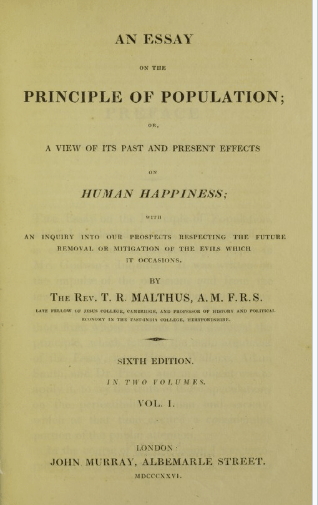
Beware: doomsday theories are seductive. In 1798, Thomas Malthus, an economist influential in his day argued (in “An Essay on the Principle of Population”), the world had insufficient farmland to feed a growing population. He predicted population growth, then just under one billion world-wide, would be reversed by disease, famine, war, or calamity. Malthus, made several revisions to his theory, the last in 1826, continuing to defend his basic premise.
Despite his wildly errant forecast, which has still not panned out centuries later, Malthus theory impacted British government policies, including those which exacerbated the Irish potato famine.
https://www.investopedia.com/terms/t/thomas-malthus.asp
Malthus argued that populations inevitably expand until they outgrow their available food supply, causing the population growth to be reversed by disease, famine, war, or calamity.
- “The Present High Price of Provisions” (1800), in which Malthus criticized England’s Poor Laws and argued that aid to the poor would encourage them to have more children than they would otherwise.
- “Observations on the Effect of the Corn Laws” (1814), in which Malthus argued in favor of importing corn from abroad rather than supporting the protectionist Corn Laws.
Despite the Irish famine and others around the world, despite misguided government policies like denying aid to the impoverished Irish, and despite the massive devastation of World War I, world population doubled by 1927. The world had not overcome war, disease, famine, or calamities that Malthus warned of, but technology and innovation proved the greater force.
Malthus couldn’t foresee the industrial revolution in its incipient stages as he developed his own theory. When he died in 1834, the industrial revolution was in full swing, including in his native UK. It changed the world for the better in so many ways he never comprehended.
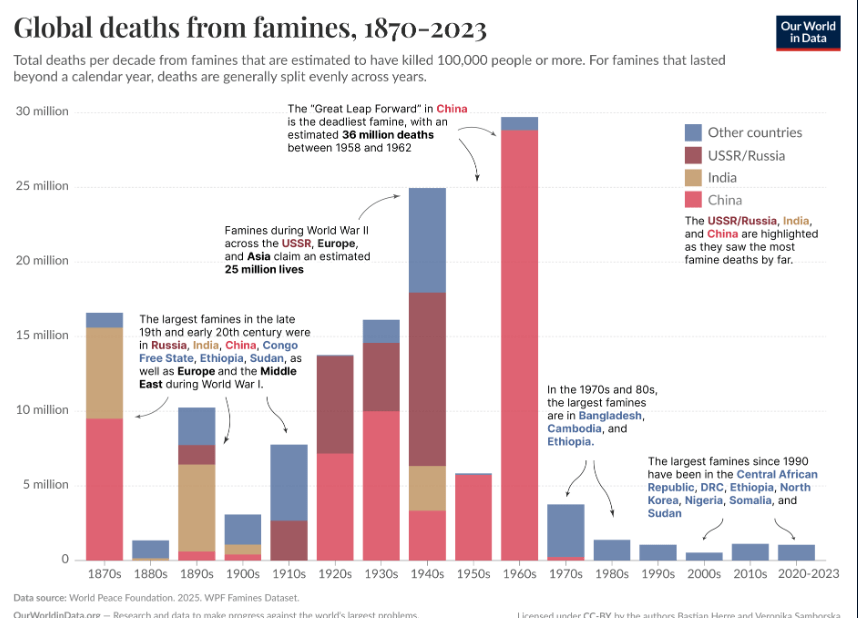
During the last hundred years, the population has quadrupled, now 8 billion+ while deaths from famines the last fifty years have been at levels lower than ever.
https://ourworldindata.org/famines
Malthus’s epitaph honored his contributions, implying his wisdom and foresight was then and would continue to be a boon to society:
His writings will be a lasting monument of the extent and correctness of his understanding.
Even though, his legacy is badly tainted, his mantle has been assumed by other respected and touted scholars, so-called experts. Perhaps Malthus was essentially correct, but ahead of his time? There has to be a limit to population size, right?
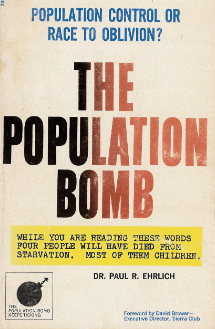
Well meaning folks are driven to re-shape culture to avoid seemingly inevitable calamities. Some organized and take action to resolve problems while others warn of the sky falling and propose grandiose, never-tried-before solutions. Paul Erlich, a Stanford biologist who died this past March, tended toward the latter; he reignited the Malthusian doctrine with his 1968 best-seller, “The Population Bomb”. Nearly two centuries after Malthus, world population had reached an unfathomable 3.5 billion. Dr. Erlich brooked no doubt regarding the imminent threat facing humanity in the book’s opening paragraph:
The battle to feed all of humanity is over. In the 1970s hundreds of millions of people will starve to death in spite of any crash programs embarked upon now. At this late date nothing can prevent a substantial increase in the world death rate.
Like Malthus before him, he thought the world’s capacity had reached its limit. However, population has grown 240% since then while malnourishment has been cut in half.
Dr. Erlich made headline-grabbing, bolder and more definitive predictions than Malthus:
- the U.S. would ration water by 1974 and food by 1980, and 65 million Americans would starve to death.
- by 1980 the average lifespan of Americans would decline to 42.
- India could not possibly feed two hundred million more people by 1980.
- England would not exist by the year 2000 due to limited resources. Hundreds of millions would die from starvation in the 1980s.
Malthus could not grasp the potential of the Industrial Revolution while Dr. Erlich missed the Green Revolution which began around the time of The Population Bomb.
https://en.wikipedia.org/wiki/Green_Revolution
The Green Revolution, or the Third Agricultural Revolution, was a period during which technology transfer initiatives resulted in a significant increase in crop yields.[1][2] These changes in agriculture initially emerged in developed countries in the early 20th century and subsequently spread globally until the late 1980s
Studies show that the Green Revolution contributed to widespread eradication of poverty, averted hunger for millions, raised incomes, increased greenhouse gas emissions, reduced land use for agriculture, and contributed to declines in infant mortality
Ironically, the “Green Revolution” was first acknowledged the same year Dr. Erlich published his book.
The term “Green Revolution” was first used by William S. Gaud, the administrator of the U.S. Agency for International Development (USAID), in a speech on 8 March 1968.
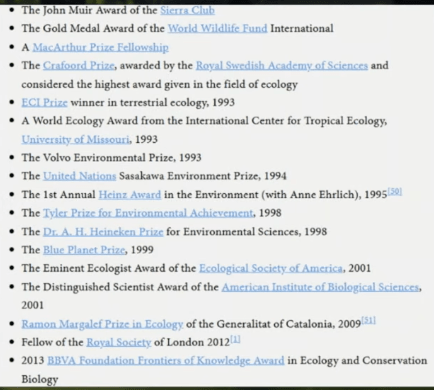
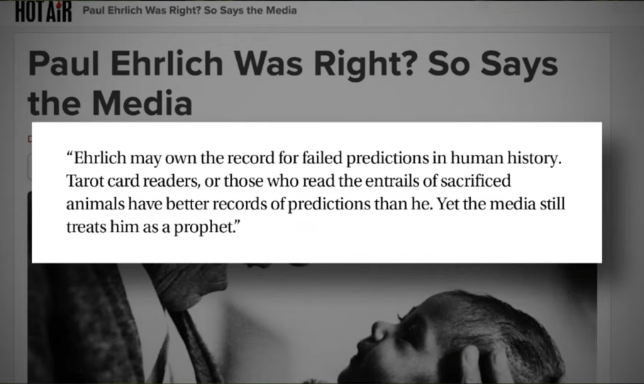
Even though Dr. Erlich’s predictions failed in an even grander fashion than Malthus, he remained a folk hero throughout his life. He was honored frequently for scientific accomplishments. A 2004 magazine interview treated his failures kindly, placing him on the forefront of contemporary issues:
https://wgbis.ces.iisc.ac.in/biodiversity/Environ_sys/doc2003-04/enda240829.html
You wouldn't know it from his humble answers to our questions, but
Paul Ehrlich is one of the few bona fide "household names" in the
world of environmentalism.  Since publication of his seminal book
"The Population Bomb" in 1968, Ehrlich has been hailed as a prophet,
criticized as a Chicken Little, and invited onto the Johnny Carson
show some 20 times.  Oh, and all the while he's forged ahead with his
world-renowned work as a conservation biologist.

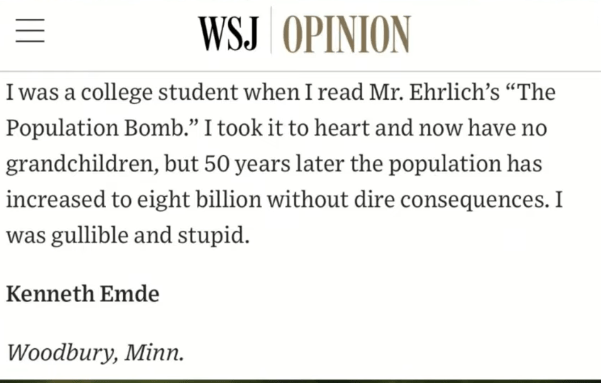
Nearly sixty years later, Dr. Erlich and his many acolytes insist his forecasts were accurate, just premature. He meant well I am sure, but he panicked many, led multitudes of unsuspecting followers astray, and worst of all, his pessimistic philosophy persists. Couldn’t we have ushered him gracefully off-stage instead of continuing to honor this “expert” for his egregious miscalculations?
Where is the Problem?
I do not propose a countervailing optimistic view that problems have been solved and population growth will never be a concern. Instead, we need a realistic view, one without visceral and emotional reactions, that examines facts dispassionately.
Foremost, we must treat Malthus and Dr. Erlich’s work as scientific theories. They were indeed serious men who offered theories regarding important issues. However, the scientific method says theories make predictions which are then tested. Copernicus in his day, proposed a theory regarding the movement of the planets; he correctly posited planets orbit the sun, but he miscalculated their paths. His theory was found wanting, so Galileo made adjustments; call them minor tweaks. Newton and Einstein built upon Galileo’s model. With each adjustment, we approach better approximations of reality, although possibly never quite reaching it. This is how science should work.
Malthus and Erlich, however, were never held to the appropriate standard. While both presented logical theories based on accurate observations, their predictions failed badly. They raised legitimate concerns about real problems, but their theories did not require “minor tweaks” as the heliocentric theory did. Their theories should have been abandoned and work started over. However, they continued to be well respected scientists, tenured professors, celebrities, etc. Their work was propped up because many wanted them to ultimately be correct. Still, the narrative should not prevail over cold hard facts.
https://www.worldometers.info/world-population/world-population-by-year/




Despite failed Malthusian predictions over centuries, we are drawn to the pessimistic view of humanity’s fate. We treat experts like Malthus and Erlich as brilliant prognosticators despite their lack of predictive success. We become emotionally attached to and never demand adjustments to failed theories. Are we seeking stimulation via real-life horror stories?
Mix this emotional attachment with politics and we create a toxic brew. These days, scientific theories are adjusted to align with worldviews; politics means proponents refuse to give any quarter to the other side, refuse to adjust theories to the facts. The broader and more important, political narrative must be protected; the science will follow.
After her election to Congress in 2018, Rep. Alexandria Ocasio-Cortez warned of imminent climate disaster within twelve years. Today, four years before “the end” arrives, we have forgotten her earlier idiocy and moved on to newer, less tested predictions of the same sort.
“Millennials and Gen Z and all these folks that come after us are looking up, and we’re like, ‘The world is going to end in 12 years if we don’t address climate change, and your biggest issue is how are we gonna pay for it?’

We remember prognosticators bravely and boldly speaking out, but not much else. Their reputations remain in tact.
Al Gore is another prognosticator given heaps of grace from supporters despite countless failed doomsday predictions:
Now, the scientific community is warning us that the average hurricane will continue to get stronger because of global warming. A scientist at MIT has published a study well before this tragedy showing that since the 1970s, hurricanes in both the Atlantic and the Pacific have increased in duration, and in intensity, by about 50 % . . . Two thousand scientists, in a hundred countries, engaged in the most elaborate, well organized scientific collaboration in the history of humankind, have produced long-since a consensus that we will face a string of terrible catastrophes unless we act to prepare ourselves and deal with the underlying causes of global warming. Al Gore, September 9, 2005

This was an easy sell because 2005 was an active hurricane year; however, during the next twelve years, no major hurricane (category three or above) struck the U.S. That was the longest quiescent stretch since meteorologists began tracking US hurricanes. Mr. Gore’s righteous indictment of fossil fuels, capitalism, and political opponents played well at the time and he is still remembered fondly for his indefatigable perseverance to save humanity, but stubborn facts don’t care about your gut feelings.
Consider also this long-term comparison: https://en.wikipedia.org/wiki/List_of_United_States_hurricanes
- Sixteen major hurricanes struck the US between 1925 and 1950, many of them unnamed still
- Sixteen major hurricanes struck the US between 2000 and 2025.

In other words: there has been no measurable change in hurricane frequency and intensity during the last hundred years despite a barrage of global warming headlines the last forty. The public should finally recognize the predictive capability of the global warming/climate change theory has been lacking.
Of course, this is just one metric among many possible, but it demonstrates that a highly touted prediction from an outspoken and well-known advocate, a prediction regularly repeated still by celebrities turned weather experts, has not materialized. It demonstrates again our emotional attachments to such theories. Perhaps Mr. Gore and Representative Ocasio-Cortez missed the mark by twenty years or perhaps the theory was unserious, only a political narrative, to begin with?

Still, disciples steadfastly believe. I am a climate denier for analyzing metrics, for tarnishing reputations, and giving credence to their political opponents. To reassure the faithful, newer and bolder predictions distract from failed past predictions.
The lesson is not to ignore warnings or dire predictions. Give them proper consideration, but also test them and hold them to account when they fail to predict, especially when missing the mark so widely.
Humanity Adapts

Malthus, Erlich, Gore, and other doomsayers do not account for humanity’s or nature’s adaptability. They garner followers because of our porous short-term memories and ignorance of history, our contemporary culture’s fatal flaws.
If humanity had remained locked into the contemporary technology, Malthus’s and Erlich’s predictions might have fared better; however, humanity’s ability to adapt and overcome all manner of difficult circumstances and seemingly impossible challenges, is arguably our species most remarkable trait, one they should not have discounted.

People adapt to limited choices and difficult circumstances while imagining something better. People have populated nature’s harshest environments, and generally thrived. People traveled thousands of miles across oceans knowing failure meant certain death while traveling on boats that would be condemned today. Hundreds of years later, men traveled hundreds of thousands of miles into space, landing on the moon in a contraption that appears to be held together by bubble gum and string. We have climbed the highest mountains, explored the oceans’ depths, and accomplished so many mind-boggling feats (now reported routinely via social media). Furthermore, this trait is not limited to the most stalwart among us; each of us overcome regularly, figuring out innovative solutions to our unique circumstances.
Malthus and Erlich, however, looked back instead of forward. They knew innovations had developed painstakingly slowly throughout most of human history. Centuries passed without a breakthrough. Man was nomadic for thousands of years; civilizations developed only after mankind learned to tame the land. The wheel came thousands of years after civilizations developed, migrating to other civilizations millennia after its discovery. The original American civilizations never had it until the 1600s. Malthus, despite being on the cusp of an era of incredible innovation and transformation, could not imagine the dramatic upheaval to come. The steam engine, the cotton gin, railroads, and other breakthroughs of the industrial revolution changed the world from the agrarian society it had been since civilization had begun and vastly accelerated the pace of change, but he couldn’t recognize their potential.
Dr. Erlich recognized Malthus’s failures, but he thought humanity had finally reached the limits Malthus had warned of. Technology had saved humanity temporarily, but it had limits too. Yet, the pace of change would increase exponentially from Erlich’s day, life-changing technology would become accessible to the entire world, and innovations would continually amaze us. The well has not run dry nearly sixty years later.
Nothing in life is worse than making mistakes and learning nothing from the experiences. Ehrlich wrote The Population Bomb immediately after he and his wife visited Delhi in 1966. He was alarmed at the vast poverty and logistical problems of feeding an impoverished people who reproduced at high rates. A few years after his book was published, in the early 1970s, problems in India lessened and he stopped highlighting them. The challenge of poverty continues to this day, but charities, businesses, governments, and ordinary people have always recognized the problem and seek to relieve suffering. It happens every day on a large and small scale. Many too find paths out of their dire situations. The pessimistic Dr. Erlich in his ivory tower never accounted for the charity and resourcefulness of others. He could only see one side of the coin, so he never altered his central premise. He set aside past failed predictions, but continued doing what he knew best: making similar radical predictions. It seemed to be all he knew.
He also blamed the Green (agricultural) Revolution for confounding his predictions, yet the Green Revolution was brought to us by folks he also blamed for our dire circumstances.
Just three years ago, when featured on Sixty Minutes, he delivered even more suspect predictions:
https://fee.org/articles/paul-ehrlich-wrong-on-60-minutes-and-for-almost-60-years/

“In ten years all important animal life in the sea will be extinct.
Large areas of coastline will have to be evacuated because of the stench of dead fish.”
He incorrectly forecasted the collapse of civilization in the next decade, but he says he made no basic mistakes? That’s bold. Perhaps in seven years his next prediction will prove true, or perhaps by then his followers will latch on to another doomsday prediction having forgotten this one.
Dr. Erlich was well known for his famous book and countless TV appearances. He influenced thoughts and actions of many followers, regrettably changing lives of those who trusted his expertise. He never served in government, but has influenced government policy and contemporary thought to this day. Many cultural changes I object were articulated by Dr. Erlich in this 1970 diatribe:
- diminishment of family and marriage
- promotion of abortion, artificial birth control, and euthanasia
- tax policy to punish
- government by the expert elite.
erlich-interview-1970 [beginning at 9:44]
Q: What ought the government do about the population explosion?
Dr. Erlich: I am against government interference in our lives. You have to minimize that . . . The very first thing the government should do is to take the pressure off to reproduce. If you are single, people are trying to push you into getting married . . . The idea is nobody should escape [marriage]. . . Young couples if they don’t have children, people say they must be sterile. They never say maybe they like good wine, going to the theater, and so on, instead of scraping diapers. So, there is pressure to have children.
The first thing that ought to happen is the president should say from here on out, no intelligent, patriotic American family ought to have more than two children, preferably one . . . not any law, but just say this is what responsible people do . . .
The FCC should see to it that large families are always seen in a negative light on television wherever they appear. There ought to be a tremendous amount of time devoted to spot commercials . . . you have a scene which says this city has a fatal disease which is called overpopulation . . .
If that didn’t have the desired effect, you could move to giving women bonuses for not having babies. That would almost certainly do the job. If that didn’t have the effect, then you could move to changing the tax structure, so that people that have money and have the children, pay for the children . . . you would increase taxes on people with children rather than decrease them . . . If that doesn’t work then you have government legislating the size of the family. And people say that is impossible . . . it intruded a while ago and told you how many wives you could have . . . If we don’t get the population under control with voluntary means, the government will simply tell you how many children you can have and throw you in jail if you have too many.
Despite his initial caveat: he was against government interference–something he completely contradicts during the remainder of his statement–he advocates for top down control of our lives. This is Plato’s notion of philosopher kings ruling via their expertise. However, his own expertise was a public failure. His morality was an even bigger failure. Few would want to live under his imposed dystopian morality.
He is like Dr. Fauci who thought his title and expertise in medicine qualified him to make public policy. Dr. Erlich, like Dr. Fauci, would have been another public policy disaster. His knowledge of biology and his overall intelligence, clearly did not extend to all realms. Yet, our media and politicians repeatedly instruct us to trust “experts” to dictate government policy. This model has failed repeatedly, from Malthus in 1798 right though today. Will we ever learn?

Gloom, despair, and agony on me
Deep, dark depression, excessive misery
If it weren’t for bad luck, I’d have no luck at all
Gloom, despair, and agony on me.
Buck Owens and Roy Clark (from TV show Hee-Haw)
Dave https://seek-the-truth.com/about/
https://seek-the-truth.com/category/life/
https://seek-the-truth.com/category/culture/
seek-the-truth.com
 Seek the Truth